VT Is Fine. Your Timeline Might Be the Problem.
When a normal market dip feels like a disaster, the issue usually isn’t the fund. It’s expectations, headlines, and watching the market too closely.
ARTICLES
4/17/20265 min read


VT Is Not Having a Crisis. We’re Having a Feelings Episode.
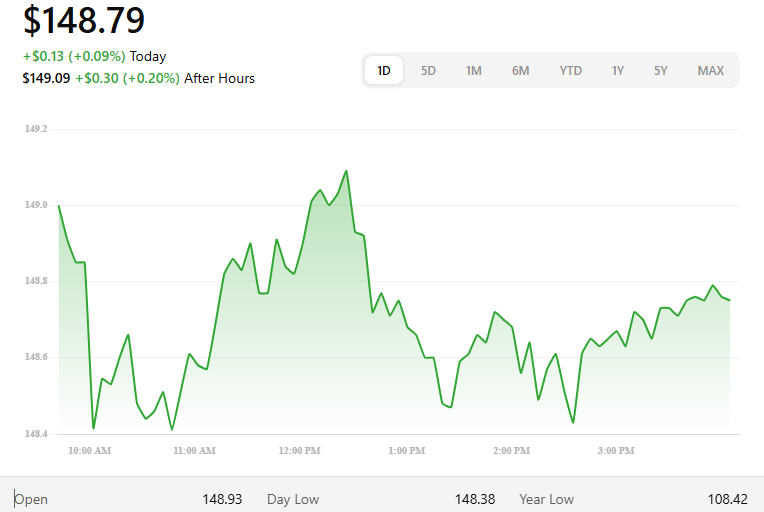
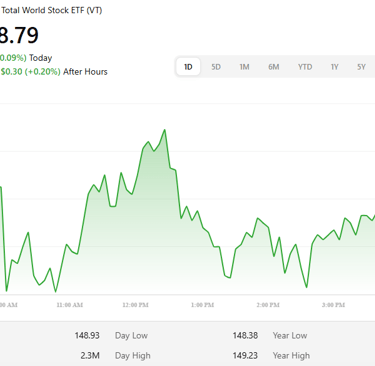
As of April 16, 2026, Vanguard Total World Stock ETF (VT) is around $148.79 and is up about 5% year to date.
That makes the angst even funnier.
Because even if VT were down 5% YTD, that is not some rare market apocalypse. That is barely worth spilling coffee over. A 5% move in stocks is the kind of thing that can happen in a rough stretch of trading and still be completely normal over a period of months. Global stock funds do not glide upward like a pension brochure. They wobble. That’s the deal.
The real question is not “Why is VT only up 5%?”
It is: Why does a normal amount of market motion suddenly feel like the floor is collapsing?
The thesis
A modest drop in a diversified global stock fund is normal. The angst usually comes from expectations, headlines, and too much screen time, not from anything structurally shocking in the portfolio itself.
1. People forgot what “stock market” means
A lot of investors say they want long-term returns, but emotionally, they want a savings account with better branding.
That’s not how this works.
VT owns stocks from around the world. Stocks are ownership in businesses. Business values move around. Prices move around more. Sometimes they move around for reasons that are sensible. Sometimes they move around because markets are a giant mood ring with Bloomberg terminals.
If your baseline expectation is “green most days, smooth most months,” then a perfectly ordinary dip feels like betrayal.
But if your baseline is “this thing is going to bounce around while compounding over decades,” then a 5% wobble barely qualifies as news.
2. Recent gains have made everyone soft
This is one of the sneaky reasons people panic over small declines.
After a strong run, investors quietly reset their definition of “normal.” Gains start to feel deserved. Flat feels annoying. Down 3% feels offensive. Down 5% feels like the opening scene of a documentary about financial ruin.
Meanwhile, the market is just doing market stuff.
A good year can make people fragile. They stop seeing volatility as a feature of equity investing and start seeing it as a bug. Then the first red patch shows up, and suddenly everybody’s acting like VT personally keyed their car.
3. Headlines are built to trigger your lizard brain
Financial media does not get paid when you feel calm, diversified, and properly allocated.
It gets paid when you click.
So a normal pullback becomes “investors rattled.” A routine re-pricing becomes “mounting fears.” A perfectly survivable dip becomes “markets in turmoil,” which usually means the S&P 500 had a grumpy afternoon and somebody needed a thumbnail with flames on it.
If you check your portfolio after reading enough scary headlines, your brain starts connecting normal volatility with actual danger.
That’s where a lot of the angst comes from.
Not from portfolio math.
From narrative overdose.
4. People confuse volatility with being wrong
This one does real damage.
An investor buys a broad, low-cost, diversified fund. Good start.
Then the fund drops a bit, and now they think the plan failed.
Nope.
A diversified stock fund going down for a while does not mean the strategy is broken. It means you bought a diversified stock fund. Those returns come with turbulence included. You do not get the long-term upside without periodically getting smacked around a little on the way there. That tradeoff is the whole game. Vanguard describes VT as a fund offering broad global equity exposure, and sources summarizing its long-run history show that it has experienced large drawdowns in the past while still delivering positive long-term compounded returns over time.
The plan was never “stocks go up every month.”
The plan was “own the world, keep costs low, keep going.”
5. The time frame is the problem
Most angst is a time-horizon mismatch wearing a market costume.
If you need the money next month, then yes, stock declines matter a lot. Stocks are risky in the short run.
If you are investing for retirement in 10, 20, or 30 years, then a 5% YTD move is basically weather. Annoying sometimes, but not a reason to sell the house.
People zoom in so far on the chart that they lose the plot. They are judging a decades-long wealth-building machine by what it did since New Year’s.
That is like rating a marriage based on one grocery trip.
Quick example
Let’s say you have $100,000 invested in a global stock fund.
A 5% drop means you are down $5,000 on paper.
That does not feel great. Nobody throws a party for that.
But it is also not weird. Not historically shocking. Not evidence that passive investing is dead, and you now need a 14-fund tactical macro strategy created by a guy with a YouTube thumbnail face.
It is just the price of admission.
And again, in the current case, VT is up about 5% YTD, which makes the panic even more revealing. Investors can feel uneasy even when the actual numbers are fine.
Where the angst is really coming from
Usually some mix of this:
Expectation creep
People expected a straight line up.
Overexposure to noise
Too much market content, too often.
Recency bias
Recent gains made normal dips feel abnormal.
Identity drama
People start tying self-worth to portfolio movements.
Lack of a written plan
Without rules, every red day feels like a referendum on your intelligence.
That’s it. Nothing mystical.
Mostly just human brains being human brains.
Do this instead
Check your allocation, not your pulse.
Read your investment plan before you read market commentary.
Remember what your fund owns: thousands of companies, not one hot stock with a cult following.
Keep buying on schedule if you are in accumulation mode.
Zoom out to years, not weeks.
Touch less, win more. Often, the highest-IQ move is doing absolutely nothing.
Common mistakes
Treating a small decline like a broken strategy
Looking at YTD returns as if January 1 is a sacred valuation checkpoint
Letting headlines bully you out of a long-term plan
Assuming “I feel nervous” means “something is wrong”
The wrap
A broad global stock fund being down for a few months would be normal.
A broad global stock fund being up while people still feel stressed is also normal.
Because the market isn’t just numbers. It’s numbers plus human psychology, and human psychology is frequently a clown car.
The fix is boring, which is great news.
Own a simple, diversified portfolio. Keep costs low. Expect volatility. Stop asking the market to behave like a checking account. Then keep going.
That’s the whole trick.
Stay the course.
Follow along for more low-cost, no-drama investing sanity. What makes people more anxious in your view: the actual market move, or the nonstop commentary around it?